


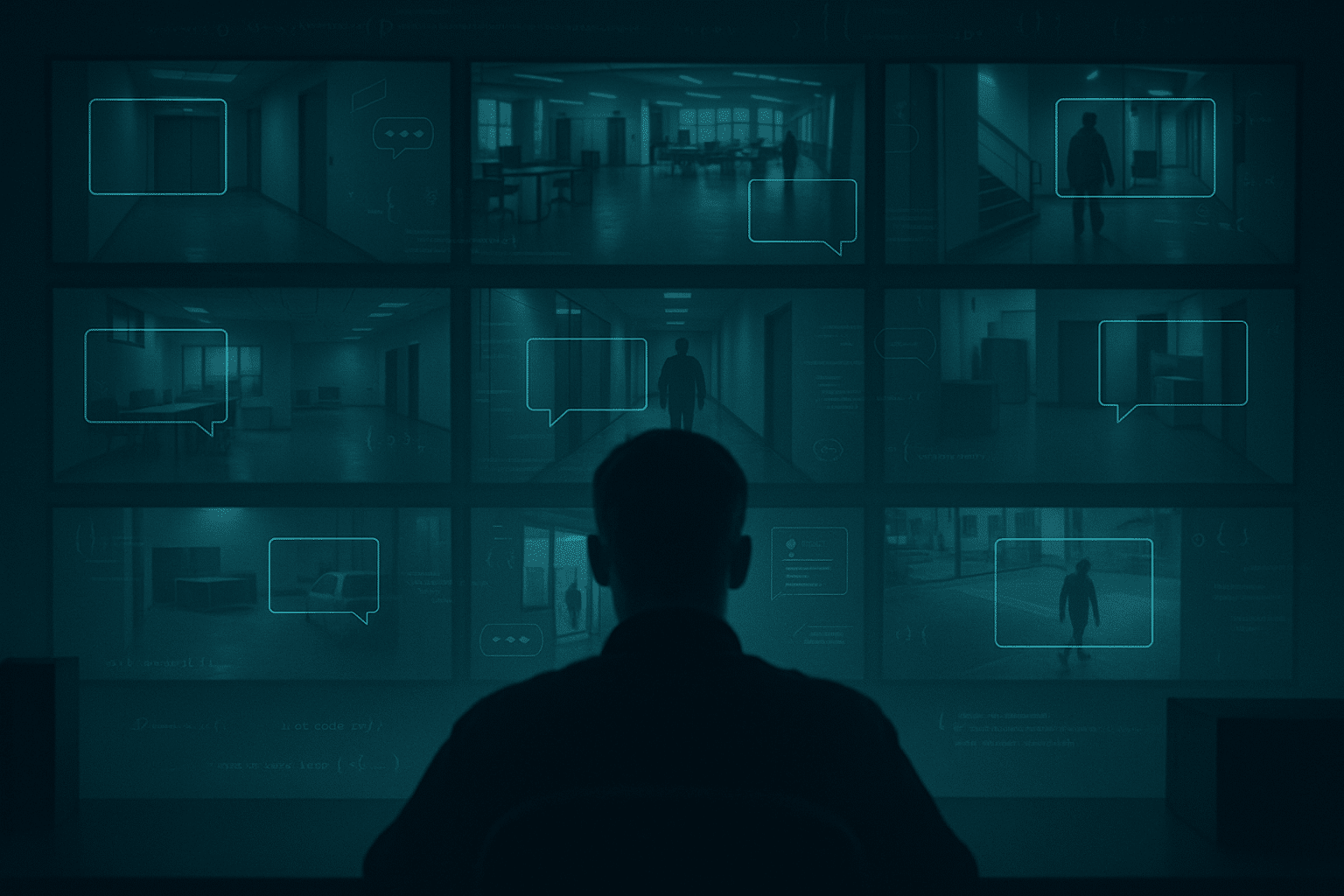
Most CCTV systems record everything and understand nothing. Vision-language (vLLM) models promise the opposite: cameras that can answer questions like “Did anyone enter the server room after 8 p.m.?” in plain English.
What happened, in plain terms
The Dark Reading piece and related coverage describe how vision‑language models (VLMs) are being explored to upgrade physical security systems:
- A VLM combines computer vision (what’s in the image/video) with natural language(what you ask it in text).
- Instead of just flagging “motion,” a system can interpret scenes: people, objects, actions, context.
- Security teams can query or task the system in everyday language, for example:
- “Alert if someone propvllms open the back door.”
- “Show me clips where a visitor tailgated an employee through a secure door.”
- Vendors are starting to integrate these capabilities into access control, video analytics, and employee safety monitoring platforms.
In enterprise settings, the idea is that VLMs watch badge-controlled doors, lobbies, or critical rooms and help detect policy violations or unusual behavior faster than human monitoring.
Why this matters (even if nothing is ‘hacked’ yet)
Even without a breach, this shift is important because:
- Security decisions become more automated. If the model is wrong — misses an intrusion or mislabels normal activity as a threat — downstream controls may respond incorrectly.
- Privacy stakes increase. Systems move from simple “record and store” to “interpret, label, and potentially profile,” which changes both legal obligations and public expectations.
- Attack surface expands. These are complex AI systems, often cloud-backed, with APIs, model endpoints, and integration points that can themselves be misconfigured or attacked.
The story is less about a single incident and more about a direction of travel: physical security becoming another AI‑driven, data‑hungry environment with security and governance requirements closer to traditional IT systems.
How attackers could abuse this in practice
From an attacker’s perspective, VLM‑enhanced physical security creates both obstacles and opportunities:
- Model evasion and manipulation
- Adversarial clothing, masks, or patterns might make people harder to detect or misclassified (for example, as “empty hallway” or “cleaner” instead of “intruder”).
- If rules are expressed in natural language (“alert when a person without a badge enters”), attackers may probe for behaviors the system does not watch for (e.g., piggybacking close behind an employee).
- Abusing the analytics layer
- If an attacker gets access to the VLM console or API, they can search video semantically:
- “Show all times a door was left open more than 30 seconds.”
- “Show all people entering the data center alone at night.”
- That makes reconnaissance far more efficient than scrubbing hours of raw footage.
- If an attacker gets access to the VLM console or API, they can search video semantically:
- Targeting the integration points
- VLMs are usually integrated with access control, HR systems, ticketing, and SIEM/SOC tools.
- Misconfigurations or weak authentication on those interfaces could let attackers:
- Suppress or flood alerts.
- Inject fake “events” (e.g., bogus tailgating incidents).
- Extract sensitive operational data about how physical security actually works.
- Data leakage and misuse
- Stored video plus AI‑generated metadata (who, where, when, doing what) is highly valuable for stalking, doxxing, or insider targeting if compromised or misused internally.
These are potential abuse patterns; real‑world impact will depend on how carefully the systems are designed and operated.
What developers and platform owners should learn
For vendors and internal development teams building or integrating VLM‑based security products, several themes emerge:
- Treat the model like critical infrastructure, not a gadget
- Apply secure‑by‑design principles to the model API, orchestration layer, and integrations, not just to edge devices and cameras.
- Enforce strong authentication and authorization for dashboards and programmatic access — the VLM console is effectively a high‑power search engine over your physical world.
- Be explicit about system boundaries and failure modes
- Document what the model is and isn’t designed to detect (e.g., tailgating, unattended packages, door propped open; but perhaps not subtle social engineering).
- Implement fallbacks and human review for high‑impact actions; avoid fully automated punitive responses (like locking doors) based solely on model output.
- Secure data pipelines end‑to‑end
- Protect video streams, extracted features, and textual descriptions with encryption in transit and at rest.
- Minimize retention and separate raw video from derived metadata where possible to reduce blast radius if something is breached.
- Design for privacy and compliance from the start
- Offer configurable redaction, blurring, and access controls on both video and AI‑generated summaries.
- Provide clear logs: who queried what (“show me all clips of X”) and when, to support audits and investigations.
What organisations and users can do right now
If your organisation is evaluating or already using VLM‑powered physical security tools:
- Map the data and access first
- Inventory:
- Which cameras feed into which AI services?
- Who can run natural-language queries over video, and via what interfaces (web UI, API, SOC tooling)?
- Restrict this to least privilege and require strong MFA.
- Inventory:
- Update risk assessments and policies
- Extend your data protection impact assessments to include:
- AI‑generated labels and summaries (which may count as personal data).
- Potential for profiling (movement patterns, working hours, social interactions).
- Align with employee privacy and workplace monitoring policies; be transparent where regulations require it.
- Extend your data protection impact assessments to include:
- Set realistic expectations for security teams
- Train operators on:
- What the system can actually detect reliably.
- Common failure and false‑positive patterns.
- Encourage a culture of “model output is evidence, not truth” — combine it with other signals, not as a single point of failure.
- Train operators on:
- Revisit incident response playbooks
- Add scenarios for:
- Compromise of the VLM dashboard or API.
- Suspected poisoning or misconfiguration that leads to widespread mis‑classification.
- Prepare procedures for quickly disabling automated actions if the AI behaves unexpectedly.
- Add scenarios for:
- Engage stakeholders early
- Involve HR, legal, and works councils/unions (where applicable) when deploying AI‑driven monitoring.
- Communicate clearly to staff what is being monitored, why, and how long data is kept.
The bigger picture
Vision‑language models in physical security are part of a broader trend: moving from passive recording to active, AI‑driven interpretation of the physical world. That can genuinely improve safety and reduce response times — but it also turns camera networks into rich, queryable datasets that must be governed, secured, and audited like any other high‑value information system.
Handled thoughtfully, VLMs can augment security teams without turning workplaces into opaque surveillance engines. Handled carelessly, they risk becoming another powerful tool that attackers — or overreaching insiders — can exploit.